
Best overall for bulky rubbish you cannot load yourself: Get Out Rubbish. Best for a small load you can transport: self-haul. Best when your deadline fits a council collection: council hard waste. This 2026 guide compares the fastest rubbish removal Melbourne options by the work you need done—not unsupported promises about arrival times.
- Get Out Rubbish is the best fit for bulky rubbish removal when you need the team to load everything.
- For fastest rubbish removal Melbourne searches, confirm the collection booking rather than relying on urgent advertising.
- Self-haul suits manageable loads; council hard waste suits deadlines that fit local collection rules.
- Same-day collection is subject to availability. Asbestos, hazardous chemicals, liquid waste, soil and sand are excluded.
Rubbish removal options at a glance
This is a ranking by practical fit for an urgent clean-up, not measured collection times. A confirmed booking, accepted waste and workable access determine which option actually meets your deadline.
| Rank and option | Best for | Standout feature | Key limitation |
|---|---|---|---|
| 1. Get Out Rubbish truck loading | Bulky waste you cannot load yourself | The team manually loads rubbish directly into trucks | Coverage is approximately 25 km from St Kilda; same-day collection is not guaranteed |
| 2. Self-haul | A manageable load with suitable transport | You organise loading and transport yourself | You must confirm the receiving facility accepts the waste |
| 3. Council hard waste | A clean-up that fits a confirmed council collection | A council collection route for eligible household items | Local eligibility, presentation and booking rules apply |
| 4. Skip-bin hire | Waste accumulating during ongoing work | A container for loading as work progresses | Delivery is not removal; the filled bin still needs collection |
| 5. Reuse or recipient collection | Usable items with a confirmed recipient | An item can leave without becoming rubbish | Collection depends on someone accepting and taking it |
Why speed means more than arrival time
A truck arriving is not the same as your property being clear. Loading, access, waste acceptance and the final collection all belong in your deadline.
For a 2026 move-out or renovation handover, ask when the rubbish will be removed—not just when someone can visit. A quote appointment alone does not confirm completion before your keys are due back.
Choose the option that removes the most obstacles from your particular job. A small load and a suitable vehicle create a different decision from a mattress upstairs or furniture in a crowded garage.
What makes the best fast rubbish removal option?
Use these criteria before choosing a service or disposal route:
- Confirmed completion: Establish whether the arrangement covers an assessment, loading or actual removal.
- Loading responsibility: Decide whether you can safely carry everything or need a team to do it.
- Waste acceptance: Describe the materials accurately before arranging transport or collection.
- Property access: Explain stairs, lifts, narrow passages and where a vehicle can legally stop.
- Service coverage: Confirm the address, not just a broad Melbourne service claim.
- Deadline fit: Match the arrangement to your handover, inspection or work schedule.
A confirmed collection that accepts your waste is more useful than an unconfirmed promise of speed. Keep that distinction in mind when comparing urgent rubbish removal offers.
1. Truck loading: best for bulky rubbish without heavy lifting
Get Out Rubbish provides household rubbish, furniture, mattress, garden waste, renovation debris, office and deceased estate clearance, and other approved non-hazardous rubbish removal. The team manually loads rubbish directly into trucks. No skip bins are provided.
This is the clearest fit when loading is the obstacle: bulky furniture, an end-of-lease pile or a garage clean-out you cannot handle yourself. You do not need to fill a bin before the rubbish can leave.
Truck-loading pros:
- The team handles the loading rather than leaving it to you.
- The service covers several stated household and commercial waste categories.
- Free on-site quotations let you assess the proposed job before agreeing.
- There is no call-out fee if you decline the on-site quote.
Truck-loading cons:
- Coverage is approximately 25 km from St Kilda, not every Melbourne address.
- Same-day collection is subject to availability, never guaranteed.
- Asbestos, hazardous chemicals, liquid waste, soil and sand are excluded.
Priority suburbs include Elsternwick, Brighton, Elwood, St Kilda, Caulfield, Prahran, Windsor, Malvern, Carnegie, Bentleigh and Hampton. Give your exact address when enquiring, especially near the edge of the service area.
Best for: Bulky approved rubbish when you need loading included. Verdict: Buy—book after the scope, quote and collection timing are confirmed.
2. Self-haul: best for a small load you can transport safely
Self-haul means taking your rubbish to a suitable receiving facility yourself. It puts the transport arrangements in your hands, but it also makes you responsible for loading, securing and unloading the waste.
For an urgent 2026 clean-up, check the facility's current opening hours and acceptance rules before loading your vehicle. A trip to the wrong destination does not clear the job.
Self-haul pros:
- You organise departure around your own schedule.
- You control which items go on the trip.
- A manageable load does not require an on-site collection appointment.
Self-haul cons:
- You need suitable transport and the ability to handle the load safely.
- The receiving facility must accept the particular materials.
- Sorting, travel and unloading remain your responsibility.
Do not choose self-haul simply because the pile looks small. A single bulky item can still be difficult to carry through a doorway or secure for transport. Check the route out of the property as carefully as the vehicle space.
Best for: A manageable load, safe lifting and a confirmed disposal destination. Verdict: Buy—choose self-haul only when the entire trip is workable.
3. Council hard waste: best for a deadline that fits local collection
Council hard waste is a collection route to check for eligible household items. Your council's current rules determine whether the property, materials and collection arrangement qualify.
Check the address-specific service before putting anything outside. A neighbour's collection arrangement is not confirmation that your property has the same entitlement or timing.
Council hard waste pros:
- It provides a council-managed route for eligible household items.
- Published local instructions give you a basis for preparing the load.
- A confirmed collection can suit a clean-up planned around that date.
Council hard waste cons:
- Eligibility, accepted materials and presentation requirements need checking.
- The collection arrangement must fit your actual deadline.
- You must follow the council's instructions about where and when to present items.
For a 2026 tenancy handover, establish whether the confirmed collection falls before the property needs to be clear. Do not treat putting rubbish on the nature strip as completion of the clean-up.
Avoid assuming that all hard rubbish belongs in one collection. Check each material category against the local instructions, particularly when household items are mixed with renovation debris or other waste.
Best for: Eligible household rubbish when the confirmed council arrangement fits your schedule. Verdict: Hold—verify the local rules and collection timing before committing.
4. Skip-bin hire: best for rubbish accumulating during ongoing work
Skip-bin hire is a separate service model: a container is delivered, filled and later collected. It suits a job where waste builds up during the work rather than a finished pile that needs loading now.
The key speed distinction is simple. Bin delivery starts the disposal process; collection of the filled bin completes it.
Skip-bin hire pros:
- Waste can be loaded as the clean-up or project progresses.
- A container gives the job a designated place for approved materials.
- Delivery and collection can be discussed as separate scheduling requirements.
Skip-bin hire cons:
- Someone still needs to load the bin.
- Placement, access and any applicable permissions need checking.
- You need to confirm the collection arrangement as well as delivery.
Ask the provider which materials are accepted before mixing waste. Do not assume a bin is suitable for everything produced during a renovation, and do not assume it can be placed wherever it is convenient.
This is not a service supplied by Get Out Rubbish. Choose truck loading instead when your requirement is for a team to carry approved rubbish out and load it directly.
Best for: An ongoing project with suitable space and people available to load. Verdict: Hold—choose a skip only when delivery, loading and collection fit the job.
5. Recipient collection: best for usable items with a taker arranged
Reuse means arranging for someone to take an item they can use. That might involve a direct recipient or an organisation, but acceptance and collection must be confirmed rather than assumed.
This option makes sense for usable furniture or other suitable possessions. It is not a dependable deadline plan while you are still waiting for someone to respond.
Recipient-collection pros:
- A usable item can continue serving its original purpose.
- You can arrange collection directly with the confirmed recipient.
- Separating wanted items reduces what remains in the rubbish pile.
Recipient-collection cons:
- Someone must agree to accept the item in its actual condition.
- Collection arrangements can fall through.
- Unclaimed items still need another removal route.
Keep reusable items separate from rubbish, and describe their condition honestly. Confirm who handles carrying and transport; an agreement to take an item does not automatically settle how it gets downstairs.
Best for: Usable items with an agreed recipient and collection time. Verdict: Skip as your only urgent plan unless collection is confirmed.
How the options are ranked
The 2026 ranking prioritises a completed clearance, loading responsibility, material acceptance, access and deadline fit. It does not claim that one provider has a measured faster response time than every alternative.
Truck loading takes the default position for bulky waste because loading is included. Self-haul moves ahead when you can safely complete the trip yourself; council collection moves ahead when its confirmed arrangement already fits your deadline.
Get a useful answer when you enquire
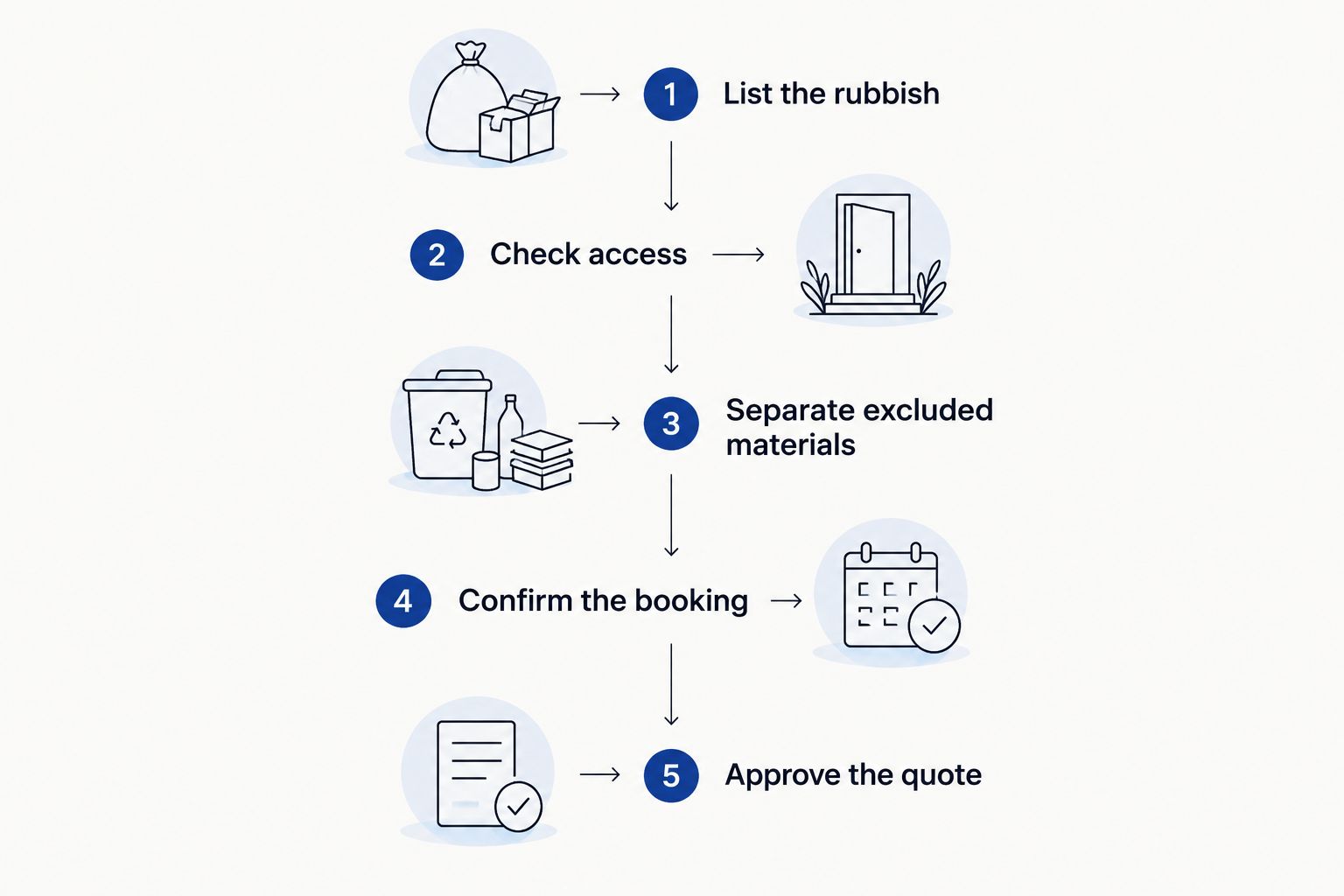
A clear job description helps establish whether a collection suits your property and rubbish. Use this sequence before requesting an urgent booking.
List the rubbish
Name the items and materials, not just the room. Say furniture, mattresses, garden waste or renovation debris rather than simply asking for a garage clearance. Explain whether you want everything removed or only selected items.
Check access
Describe stairs, lift access, narrow doors and the route to the collection vehicle. For an apartment, check building access requirements and any arrangements needed with the property manager before agreeing to a time.
Separate excluded materials
Keep asbestos, hazardous chemicals, liquid waste, soil and sand out of the proposed collection. If you cannot identify a material, describe that uncertainty before anyone handles it; do not hide it inside a mixed pile.
Confirm the booking
Give your suburb and required completion date. Ask whether the proposed visit is for a quotation or also includes collection, and explain any key return, inspection or building access deadline.
Approve the quote
Check that the on-site quote covers the rubbish you want removed. Point out items that must stay, and agree on the scope before loading begins.
For a 2026 collection enquiry, call 0480 350 234. Operating hours are Monday–Saturday, 7:00 am–7:00 pm; Sunday and public holidays are normally closed. Same-day collection remains subject to availability.
Request your on-site rubbish quote
The team loads approved rubbish. No skip bins and no call-out fee if you decline the on-site quote.
Which rubbish removal option should you choose?
Choose Get Out Rubbish for bulky rubbish removal when you need the team to handle loading within the stated service area. Request a free on-site quote and confirm the collection timing before treating the job as booked.
Choose self-haul for a manageable load with a suitable destination. Use council hard waste when the local arrangement fits, a skip for ongoing loading, and recipient collection for usable items with a confirmed taker.
FAQ
What’s the fastest rubbish removal option in Melbourne?
The fastest suitable option is the one with confirmed collection timing, accepted waste and workable access. Truck loading suits bulky rubbish you cannot move yourself; self-haul suits a manageable load with suitable transport and a confirmed receiving facility.
Can Get Out Rubbish collect rubbish on the same day?
Same-day collection is subject to availability and is never guaranteed. Call 0480 350 234 with your suburb, rubbish description and access details to discuss your required timing.
Do I need to load the rubbish myself?
The truck-loading team manually loads approved rubbish directly into trucks. No skip bins are provided; explain stairs, lifts and difficult access when enquiring.
Which Melbourne suburbs does the service cover?
Coverage is approximately 25 km from St Kilda, Melbourne. Priority suburbs include Elsternwick, Brighton, Elwood, Caulfield, Prahran, Windsor, Malvern, Carnegie, Bentleigh and Hampton; confirm your exact address when enquiring.
Is there a call-out fee if I decline the quote?
There is no call-out fee if you decline the free on-site quotation. Confirm the rubbish included in the quote before agreeing to removal.
What rubbish cannot be collected?
Asbestos, hazardous chemicals, liquid waste, soil and sand are excluded. Describe unfamiliar or mixed materials before booking rather than assuming they are accepted.
Should I choose a skip bin or truck loading for a move-out?
Choose truck loading when you need the team to carry and load approved rubbish. A skip is a different arrangement requiring loading and later collection, so confirm both stages against your handover deadline.
One last thing
Walk through the property before loading starts and identify what must stay. In a shared garage, office or deceased estate, the item beside the rubbish pile is not necessarily rubbish. A clear removal boundary matters as much as a clear access path.
Related guides
- Same-day rubbish removal options in Melbourne
- End-of-lease rubbish clean-up options
- Rubbish removal options for strata properties
- Skip-bin alternatives for a one-off clean-up