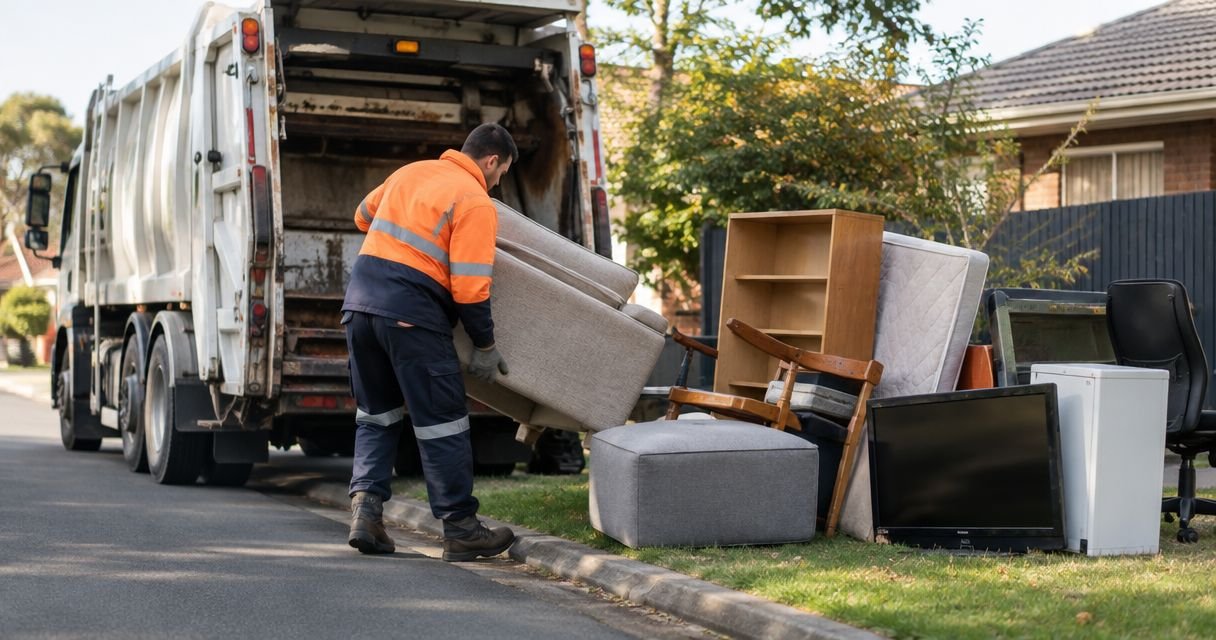

Instead of chasing missing details after collection, organise your NDIS rubbish removal invoice workflow before you book: confirm funding responsibility, agree the quote, record the completed work and send the invoice to the nominated payer. This 2026 guide separates permission to collect rubbish from approval to pay an invoice—neither automatically establishes NDIS eligibility.
- An NDIS rubbish removal invoice does not establish funding eligibility; confirm the proposed support before booking.
- Get Out Rubbish Pty Ltd suits local rubbish removal customers who want the team to load directly into trucks.
- Keep the quote, written authorisation, service record and invoice consistent.
- Confirm the payer and submission requirements before collection, not after an invoice is rejected.
Why this matters
A rubbish removal quote describes a job. An NDIS payment decision concerns whether that job is an eligible support under the participant’s arrangements. Accepting a quote is not the same as approving an NDIS claim.
For a 2026 collection, settle both questions before work starts. Otherwise, a completed clearance can leave the participant, representative and provider disagreeing about who must pay.
Get Out Rubbish Pty Ltd is best for local rubbish removal customers who want the team to load directly into trucks rather than supply a skip bin. You can get a quote for the physical work, while separately confirming whether the proposed support can be funded.
Before you start
- Prepare the job details: the collection address, rubbish list, access restrictions, preferred date and the person authorised to approve the work. Share participant information only with consent and only where needed.
- Identify the payment arrangement: self-managed, plan-managed or NDIA-managed funding, plus the person responsible for checking eligibility and invoice requirements. For NDIA-managed supports, registered-provider requirements apply; do not assume a rubbish removal business meets them.
- Resolve the gotcha first: ordinary household expenses do not become eligible NDIS supports simply because an invoice mentions disability. Ask the relevant funding contact to confirm the proposed support before authorising collection.
You do not need a particular invoicing app to follow this process. Email and a clear job record are enough, provided the people responsible can identify the current quote and approval.
Job scope and funding checks
Define the collection
- List the rubbish. Separate furniture, mattresses, household rubbish, green waste and renovation debris. Describe the actual items rather than using a vague label such as general assistance.
- Describe access. Include stairs, lift access, parking restrictions, narrow passageways and the distance between the items and truck access. Identify anything that must remain untouched.
- Check the service area. Get Out Rubbish Pty Ltd serves approximately 25 km from St Kilda, including surrounding suburbs such as Elwood, Elsternwick, Brighton, Caulfield and Prahran. Confirm the address before arranging access.
- Disclose unsuitable materials. Do not include asbestos, hazardous chemicals, liquid waste, soil or sand in the proposed collection. If a material is unidentified, flag it before anybody handles it.
Expected result: everyone has the same written description of the collection, without assuming that every item is suitable for removal or NDIS funding.
Confirm who can authorise payment
- Identify the management arrangement. Ask whether the relevant support is self-managed, plan-managed or NDIA-managed. Do not infer this from who answers the phone.
- Ask about eligibility and provider requirements. Describe the job accurately and ask the responsible funding contact to check it against the participant’s circumstances and applicable rules. Do not select a support item merely because its wording looks close.
- Record payment responsibility. Establish who authorises the work, who receives the invoice and who is responsible if funding is not available. Resolve this before booking, rather than adding it to the invoice afterwards.
Expected result: you have a named decision-maker and a documented payment arrangement. A conversation about possible funding is not yet authority to proceed.
Choose the correct approval route
These are payment arrangements, not interchangeable booking methods. Use the route that actually applies to the participant in 2026.
| Arrangement | Best for | Practical advantage | Limitation to resolve |
|---|---|---|---|
| Self-managed | Participants managing their own support payments | The participant can keep the quote and payment records together | The participant must check eligibility and retain appropriate records |
| Plan-managed | Participants using a plan manager for payment administration | Invoice requirements can be confirmed with the nominated plan manager | Payment administration does not make an otherwise ineligible expense eligible |
| NDIA-managed | Participants whose relevant support is managed by the NDIA | The provider requirements can be checked before a booking | Registered-provider requirements apply; do not assume this service qualifies |
Do not change the management arrangement on paperwork to make a booking fit. If provider requirements cannot be met, stop the funded booking process and clarify the available options with the participant’s funding contact.
Quote and collection authorisation
Get a quote that matches the job
- Request an on-site assessment. Get Out Rubbish Pty Ltd offers free on-site quotations, with no call-out fee if you decline the quote. The team manually loads rubbish directly into trucks; no skip bins are provided.
- Check the scope before accepting. Confirm which items are included, what stays, the access arrangements and any exclusions. Make sure the quote identifies the correct customer and collection address.
- Send the quote for the agreed funding check. Include the factual job description and any requested supporting information. Ask for a clear response, rather than treating silence or receipt of the quote as approval.
- Keep the accepted version. If the rubbish list changes, update the scope and obtain fresh authorisation where required. Do not rely on an earlier approval for additional work.
Expected result: the accepted quote describes the collection that will actually happen, and the person authorising it understands the payment arrangement.
Book only after the checks are complete
- Confirm the collection date. Same-day collection is subject to availability, never guaranteed. For a time-sensitive job, explain both the clearance deadline and any outstanding approval steps.
- Arrange access and supervision. Nominate someone who can identify the approved items and resolve questions on site. Tell the team about access needs without sharing unnecessary medical information.
- Set a change rule. Agree that additional items or changed access conditions must be discussed before extra work proceeds. The person present on collection day is not automatically authorised to expand a funded job.
Operating hours are Monday–Saturday, 7:00 am–7:00 pm. Sunday and public holidays are normally closed, so do not build an approval schedule around an assumed Sunday collection.
Expected result: the booking has an agreed scope, an access contact and a clear instruction for handling changes.
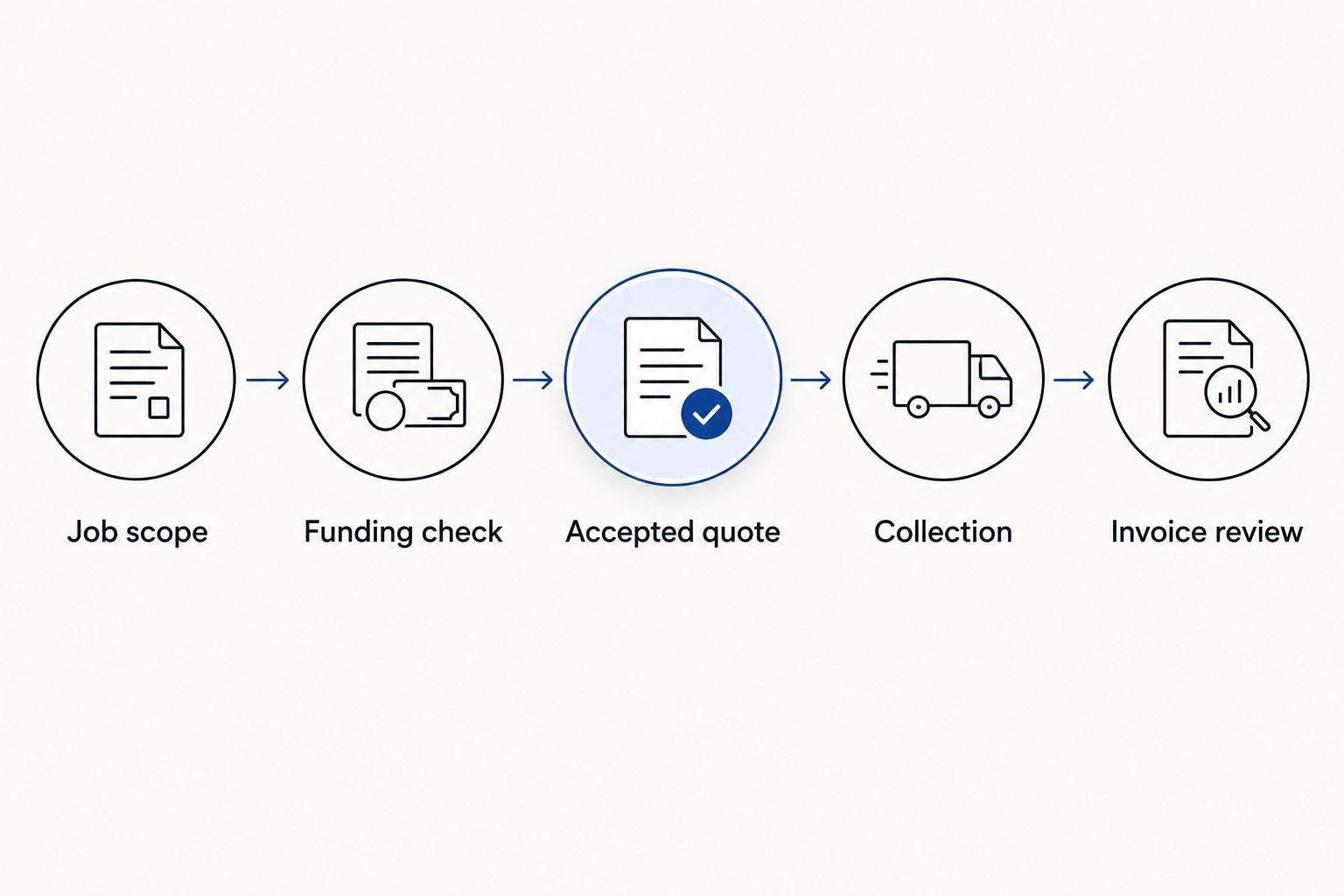
The paperwork follows the work, not the other way around. A well-formatted invoice cannot repair a collection that went ahead without the necessary authorisation.
Service records and invoice submission
Record what was completed
- Confirm the actual service date. Use the date the collection occurred, not the date the quote was requested or accepted.
- Describe the completed work. Record the items removed and any agreed changes. If only part of the quoted collection was completed, make that clear.
- Keep evidence proportionate. Retain the accepted quote, authorisation and completion record. Take photographs only with appropriate permission, avoiding people, private documents and unrelated belongings.
Expected result: the service record explains what happened without requiring the payer to reconstruct the job from messages.
Check the invoice before sending
- Check supplier and customer details. Confirm the supplier’s legal identity, ABN and contact details, together with the participant or customer information requested by the payer.
- Check the document identifiers. Use a unique invoice reference, issue date and service date. Include the quote reference where it helps connect the records.
- Use an accurate service description. Describe the actual rubbish removal. Use an NDIS support item only where its applicability has been confirmed; do not substitute an unrelated item to obtain payment.
- Check the payment and tax details. Ensure the invoice total matches the authorised work and that applicable tax treatment is correct. Do not assume a service is GST-free merely because the customer is an NDIS participant.
- Send through the nominated channel. Confirm the recipient and any required participant identifier or attachment before sending personal information.
Expected result: the payer receives a traceable invoice supported by matching records. Submission is not a payment guarantee.
For households coordinating cleaning and clearance, NDIS plan manager invoicing needs a clear distinction between each provider’s work: a cleaning authorisation should not be treated as approval for a separate rubbish collection. Keep the descriptions and supporting records distinct, even when both services happen at the same address.
When the collection changes after quote approval
A changed collection needs a fresh scope check, not just a different invoice. This applies when extra furniture appears, access changes or the participant wants to retain items originally listed for removal.
- Pause the changed portion. Identify exactly what differs from the accepted quote.
- Update the written scope. Separate the original work from additions or omissions.
- Return to the authorised decision-maker. Confirm any funding implications before the additional work proceeds.
- Reconcile the final record. Make the completion notes and invoice reflect the work actually authorised and performed.
Expected result: you retain a clear trail from quote to collection to invoice, rather than asking the payer to approve an unexplained difference retrospectively.
For another collection later in 2026, reuse the checklist—not the old approval. A previous invoice payment does not establish eligibility for a different job.
Troubleshooting
The invoice was returned for missing details
Ask the payer to identify the missing fields, then have the supplier issue a corrected document. Retain the correction trail so the revised invoice is not mistaken for an additional charge. Do not edit a supplier’s invoice yourself.
The invoice does not match the approved quote
Compare the accepted scope with the completion record. Ask the supplier to explain the difference and provide the relevant authorisation; if the invoice is incorrect, request a correction rather than rewriting the job description to force a match.
The support item or funding category is disputed
Pause the payment request and ask the responsible funding contact to resolve the classification. Do not try alternative support items until one passes. Accurate descriptions protect the participant and the provider from an incorrect claim.
An invoice has been sent twice
Identify the original invoice reference and tell the recipient that the second submission is a duplicate. Keep one record of the payment status. If a replacement document is needed, make its relationship to the original clear.
The collection deadline arrives before approval
Tell the participant or authorised representative that the funded booking is not ready to proceed. If they choose another payment arrangement, document that decision before work starts; do not promise reimbursement or assume later approval will cover it.
Customise your workflow
Build one job record with separate sections for scope, authorisation, completion and payment status. Give each collection its own reference, especially when a household also has cleaning, gardening or moving services involved.
For an end-of-lease clearance, record which belongings remain and who can authorise removal. For a deceased estate, establish the authorised contact before collection. For office or commercial rubbish, keep that work distinct from any participant-related enquiry rather than combining everything under an NDIS description.
To discuss a local collection, call 0480 350 234 or use the contact page. Explain the rubbish, suburb, access and approval status so the conversation starts with the actual job.
Request an on-site rubbish quote
Free on-site quotation. No call-out fee if you decline the quote.
FAQ
Does an NDIS rubbish removal invoice guarantee payment?
No. An NDIS rubbish removal invoice records a service and payment request; it does not establish funding eligibility. Confirm the proposed support, provider requirements and payment responsibility before booking.
What details should I check on a rubbish removal invoice?
Check the supplier identity and ABN, customer details, invoice reference, issue date, service date, accurate work description and payment details. Confirm any additional requirements with the nominated payer before submission.
Can a plan manager approve any household rubbish collection?
No. Plan management does not turn an ordinary household expense into an eligible NDIS support. Ask the plan manager to check the proposed service against the participant’s circumstances and applicable funding rules before authorising work.
Can I book Get Out Rubbish Pty Ltd for an NDIA-managed support?
Do not assume the service meets NDIA-managed provider requirements. Confirm registration requirements and the provider’s status before arranging any funded work; a rubbish removal quote alone does not establish suitability.
What happens if more rubbish is added after approval?
Pause the additional work and obtain an updated scope and authorisation. The final invoice should reflect the work actually approved and completed, not an unexplained expansion of the original collection.
Is same-day collection guaranteed once my paperwork is ready?
No. Same-day collection is subject to availability. Confirm the booking directly after resolving the required funding checks and authorisation.
Should an NDIS rubbish removal invoice be GST-free in 2026?
Do not assume the invoice is GST-free because the customer is an NDIS participant. The supplier must apply the correct tax treatment to the actual supply, with accounting advice where needed.
One last thing
Keep approval to perform the job separate from approval to pay the invoice. Before a 2026 collection, confirm both the authorised scope and the payment arrangement in writing. That distinction is more useful than adding NDIS to an invoice heading after the truck has left.
Related guides
- Same-day rubbish removal options in Melbourne
- Ways to get rid of old furniture in Melbourne
- Options for mattress disposal in Melbourne