
Best overall for bulky, mixed garage rubbish: team-loaded removal from Get Out Rubbish. Best for reusable belongings: donation; best for a small, self-managed clear-out: a confirmed council collection or an approved drop-off facility. This 2026 guide compares six ways to clear a Melbourne garage, with the lifting, sorting and disposal limits made clear.
- For garage clean out Melbourne enquiries, Get Out Rubbish suits bulky, approved non-hazardous rubbish that needs team loading.
- Donate usable belongings and sell worthwhile items before arranging rubbish removal.
- Check council collection rules before placing anything outside your property.
- Separate chemicals, liquids and unidentified renovation materials before booking a garage clearance.
Why this matters
A garage clear-out involves more than getting everything out of the room. You need to decide what stays, what someone else can use and what requires an appropriate disposal route.
Get Out Rubbish is best for Melbourne garage clean-outs where you need approved non-hazardous rubbish loaded directly into a truck. The service covers approximately 25 km from St Kilda, including surrounding suburbs such as Elwood, Brighton, Caulfield, Carnegie and Bentleigh. Confirm your address and rubbish types when enquiring.
For a 2026 clean-out, choose the removal method before dragging heavy belongings outside. That keeps your plan tied to an accepted collection arrangement rather than an assumption.
What makes the best garage clear-out method?
Choose against these criteria, not just the size of the pile:
- Loading responsibility: Who carries furniture, bags and awkward objects out of the garage?
- Material acceptance: Does the collection or facility accept each waste type you have?
- Access: Describe narrow driveways, steps, shared entrances and parking restrictions before booking.
- Timing: Does the arrangement fit your handover, renovation or household schedule?
- Reuse potential: Separate useful belongings before treating the whole garage as rubbish.
- Preparation required: Check whether you must sort, transport or position items yourself.
No single method does every job. Selling a working tool and removing a broken cupboard are different tasks, even when both are part of the same garage clearance.
Garage clear-out options at a glance
| Method | Best for | Standout feature | Key limitation |
|---|---|---|---|
| Team-loaded rubbish removal | Bulky, mixed non-hazardous rubbish | The collection team loads directly into a truck | Excluded materials need another route |
| Council hard rubbish collection | Accepted items without an urgent deadline | Uses your council's collection arrangements | Eligibility, item rules and timing need checking |
| Donation or gifting | Usable belongings you no longer need | Keeps useful items in use | Acceptance and handover must be confirmed |
| Selling selected items | Belongings worth organising a sale for | You choose which items to offer | Enquiries and collection require your time |
| Approved drop-off facility | A small, sorted load you can transport safely | You handle the drop-off yourself | You handle loading, transport and unloading |
| Skip bin hire | A staged clean-out with self-loading | A container stays on site during the work | You need suitable placement and must load it |
1. Team-loaded removal: best for bulky garage rubbish
Team-loaded removal suits a garage containing unwanted furniture, household rubbish and other approved non-hazardous items. Get Out Rubbish manually loads rubbish directly into trucks; no skip bins are provided.
Best for: A substantial garage clear-out where you do not want to carry the rubbish yourself.
You can request a free on-site quotation. There is no call-out fee if you decline the quote, so you can confirm the scope before agreeing to the removal.
Team-loaded removal pros:
- The team carries and loads the agreed rubbish.
- No skip bin needs to remain at the property.
- The on-site quotation lets you identify what should go.
Team-loaded removal cons:
- Asbestos, hazardous chemicals, liquid waste, soil and sand are excluded.
- Service area, access and collection timing need confirmation.
For a 2026 booking, explain whether the garage contains furniture, mattresses, garden waste or renovation debris. Identify questionable materials separately rather than mixing them into bags.
Verdict: Buy this service when lifting and loading are the main obstacles. Confirm the accepted load before work begins.
2. Council collection: best for accepted items without urgency
A council hard rubbish collection is an option when your items fit your municipality's current rules. Check the official council information for your address before choosing this route.
Best for: A non-urgent clear-out containing items your council explicitly accepts.
Do not assume that neighbouring Melbourne suburbs share the same arrangements. Confirm booking requirements, collection instructions and any limits that apply to your property.
Council collection pros:
- You can plan around a confirmed collection arrangement.
- Published acceptance rules help you sort the load.
- It offers an alternative to transporting accepted bulky items yourself.
Council collection cons:
- Your preferred timing must fit the council's arrangements.
- You remain responsible for following presentation and item rules.
Before using council collection in 2026, check whether your particular furniture, appliances and renovation leftovers are accepted. Keep anything outside those rules separate.
Verdict: Hold until your council confirms eligibility, accepted items and collection instructions. Do not put a mixed garage pile on the nature strip and assume it will be collected.
3. Donation or gifting: best for useful belongings
Donation and gifting suit belongings that remain usable and that a recipient agrees to take. Think in terms of the next person's use, not simply your need to clear space.
Best for: Serviceable furniture, tools and household belongings with a confirmed recipient.
Describe the condition honestly. Send photographs and disclose damage before arranging a handover; an item that needs repair should not be presented as ready to use.
Donation or gifting pros:
- Useful belongings can stay in use.
- You separate reusable items from genuine rubbish.
- You can arrange a direct handover with an interested recipient.
Donation or gifting cons:
- A charity or recipient must agree to accept the item.
- Transport and collection arrangements still need organising.
Do not leave goods outside a charity's premises without permission. Confirm what the organisation accepts and whether you must deliver it yourself.
Verdict: Hold until acceptance and handover are confirmed. Keep a backup removal plan for anything that remains when the garage needs to be empty.
4. Selling selected items: best for worthwhile individual sales
Selling makes sense for belongings you are willing to photograph, describe and manage enquiries about. Treat it as a separate task from rubbish removal, not as the default destination for everything.
Best for: Selected tools, furniture or equipment you consider worth the effort of a sale.
Choose a collection deadline before listing. If your garage must be empty for a move or renovation, leave room in the schedule for items that do not sell.
Selling selected items pros:
- You control which belongings are offered for sale.
- Buyers can assess an accurate description and photographs.
- You can arrange collection directly with the buyer.
Selling selected items cons:
- Messages, inspections and handovers take your time.
- A listing does not guarantee a completed sale.
Keep sold, listed and unwanted items clearly separated. Otherwise, a collector arriving for one object can find it buried behind the rubbish you still need removed.
Verdict: Hold for selected items only. Skip selling belongings when managing the sale conflicts with your clearance deadline.
5. Approved drop-off: best for small, sorted loads
Taking rubbish to an approved facility gives you responsibility for the entire trip. Check the facility's current acceptance rules before loading your vehicle.
Best for: A manageable load you can lift, transport and unload safely.
Confirm the exact materials involved. A general description such as garage rubbish does not tell a facility whether you have timber, an appliance, paint containers or mixed household waste.
Approved drop-off pros:
- You organise the trip around the facility's opening hours.
- You can separate materials before leaving home.
- You control which items travel in each load.
Approved drop-off cons:
- You handle the lifting at both ends.
- Vehicle suitability and load restraint are your responsibility.
For a 2026 clear-out, check the destination before making the trip. Do not put unidentified liquids or suspected asbestos into a vehicle as ordinary rubbish.
Verdict: Hold until the facility confirms acceptance. Skip self-hauling if the load exceeds what you can handle safely.
6. Skip bin hire: best for a staged, self-loaded clean-out
Skip bin hire is a different service from truck-based rubbish removal. You arrange a container and load accepted material into it during the hire period.
Best for: A gradual clear-out where you have suitable placement and can do the loading.
Check placement requirements with the provider and relevant authority before arranging a bin. The skip bin alternatives for a one-off clean-up guide helps distinguish a container-based job from team-loaded collection.
Skip bin hire pros:
- You can add accepted rubbish as the clean-out progresses.
- The container provides a defined place for the waste.
- It suits a project where you are managing the loading.
Skip bin hire cons:
- You must arrange suitable placement and any required permissions.
- You do the lifting and follow the provider's material restrictions.
Get Out Rubbish does not provide skip bins. Its team loads agreed rubbish directly into trucks instead.
Verdict: Buy skip bin hire only when self-loading and placement suit your property. Skip it when carrying the rubbish is the problem you need solved.
How these methods are ranked
The ranking prioritises loading responsibility, accepted materials, access, timing, reuse and preparation. Team-loaded collection comes first for bulky rubbish because it addresses the carrying as well as the removal.
Donation and selling serve a different purpose: finding another user for selected belongings. Council collection, self-hauling and skip hire remain options when their requirements match your load and your ability to prepare it.
This is a task-based comparison, not a claim that every garage needs a paid collection. Match the method to the items, then check the actual collection conditions.
Prepare your garage before collection
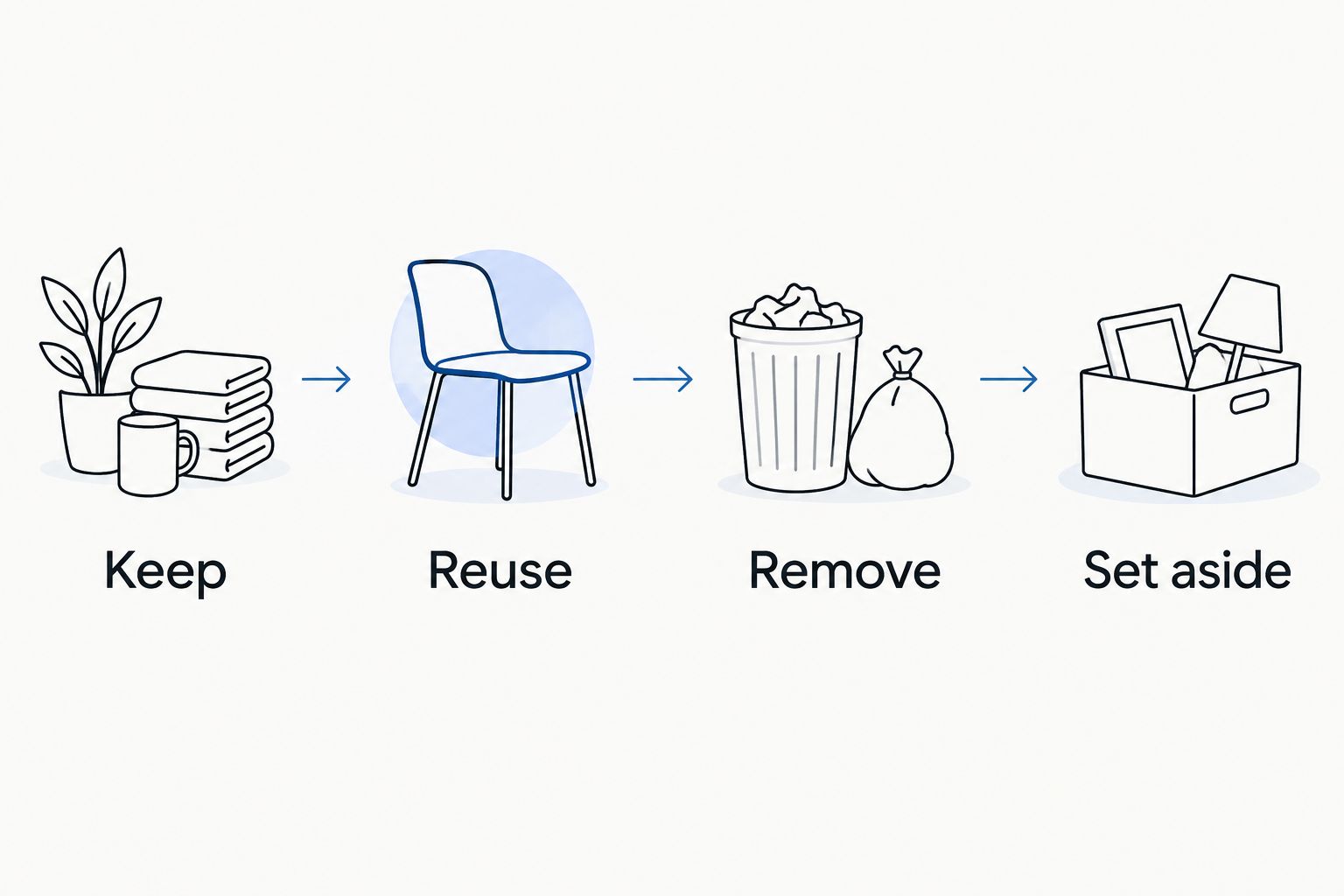
Use a simple sequence so useful belongings do not disappear into the rubbish pile:
- Keep: Mark belongings that must stay, including tools, documents and family possessions.
- Reuse: Separate items intended for a confirmed buyer or recipient.
- Remove: Identify the approved rubbish you want quoted and collected.
- Set aside: Keep excluded or unidentified materials out of the removal load.
Leave belongings you intend to keep clearly marked. Do not attempt to move an unstable stack or heavy object simply to make the garage look ready.
Tell the removal team about steps, restricted driveway access, locked gates and shared entrances. If another person is authorising the clear-out, settle which items can leave before collection starts.
For renovation leftovers, disclose the material rather than calling everything building waste. Asbestos, hazardous chemicals, liquid waste, soil and sand are not accepted by this service.
Which garage clear-out method should you choose?
Choose team-loaded removal if your priority is getting bulky, approved rubbish out without doing the carrying. Choose donation or selling for useful belongings, then arrange an appropriate route for what remains.
To request a free on-site quotation from Get Out Rubbish, call 0480 350 234. Provide your suburb, the rubbish types and the access details; confirm coverage rather than assuming every Melbourne address is included.
Hours are Monday–Saturday, 7:00 am–7:00 pm. Sunday and public holidays are normally closed. Same-day collection is subject to availability, never guaranteed.
Request your garage clear-out quote
Free on-site quotation. No call-out fee if you decline. The team loads approved rubbish directly into trucks.
FAQ
What’s the best way to clear out a garage in Melbourne?
Team-loaded rubbish removal is the best fit when you need bulky, approved non-hazardous rubbish carried out and loaded. Separate usable belongings first, and confirm access, accepted materials and collection timing before booking.
Do I need to carry everything out of the garage first?
Get Out Rubbish manually loads agreed rubbish directly into its trucks. Explain where the items are located and disclose steps, narrow access or other obstacles when requesting your quotation.
Can I book a same-day garage clean-out?
Same-day collection is subject to availability and is not guaranteed. Call 0480 350 234 with your suburb, rubbish types and access details to discuss a suitable collection.
Does the garage removal service include a skip bin?
No skip bin is provided. The team manually loads approved rubbish directly into trucks, so this is different from hiring a bin and filling it yourself.
What garage waste cannot go with this service?
Asbestos, hazardous chemicals, liquid waste, soil and sand are excluded. Identify questionable materials before booking and arrange an appropriate disposal route separately.
Is there a charge if I decline the on-site quote?
There is no call-out fee if you decline the free on-site quotation. Confirm the items included in the quote before agreeing to the removal.
Which Melbourne suburbs does the service cover?
Coverage is approximately 25 km from St Kilda, including nearby suburbs such as Elwood, Brighton, Caulfield, Prahran, Carnegie and Bentleigh. Confirm your exact address when enquiring.
One last thing
Make the keep pile unmistakable. Mark the cupboard, toolbox or family belongings that must remain, rather than relying on a quick conversation beside a crowded garage.
For your 2026 clean-out, a clear removal boundary is more useful than a perfectly tidy pile. Confirm what leaves, what stays and what needs separate disposal before loading begins.
Related guides
- Ways to get rid of old furniture in Melbourne
- Ways to dispose of old white goods in Melbourne
- Deceased estate clean-out options in Melbourne